
Search Sitka Traffic Court Records
Traffic Court Records in Sitka City and Borough help you find a state traffic case, confirm whether a citation has reached the Alaska Court System, and request copies when you need the docket, judgment, or final disposition. The Sitka Superior & District Court is the main office for those searches, and the records portal can usually tell you whether a case is active, paid, delayed, or still being entered. If you are starting with only a name or a ticket number, the Sitka records path gives you a practical way to move from a paper citation to the filed case record without guessing which office should answer first.
Sitka Traffic Court Records at the Superior & District Court
The Sitka court office is the Sitka Superior & District Court directory, and the listing places the courthouse at 304 Lake Street, Room 203, Sitka, AK 99835. The phone number is (907) 747-3291, the fax number is (907) 747-6690, and the records email is 1SImailbox@akcourts.gov. When you need a direct answer about a traffic file, those are the first contact points that matter because they connect you to the clerk who actually handles the local court record rather than a generic statewide queue.
The Sitka location uses the CourtView prefix 1SI. That prefix matters because it narrows the search to the right judicial location and keeps you from mixing Sitka matters with another Alaska district. CourtView is the public case system at records.courts.alaska.gov, and it is the fastest way to see whether a traffic case has been filed, whether the docket has been updated, and whether any financial tab or hearing note has been added. Like every Alaska district office, Sitka can take a few days to enter new information, so a citation written recently may not appear immediately.
One small but useful Sitka detail is that the court directory also notes a jury recorded message at extension 2. That is not traffic-specific, but it helps keep the courthouse contact information in one place when a caller is trying to confirm what the office is handling that day. For traffic records, the more important issue is whether the citation is already in the court system and whether the file is complete enough for you to request a copy or confirm a hearing date.
The official Sitka court directory at courts.alaska.gov/courtdir/1si.htm is the best place to verify the courthouse address before you ask for a record.
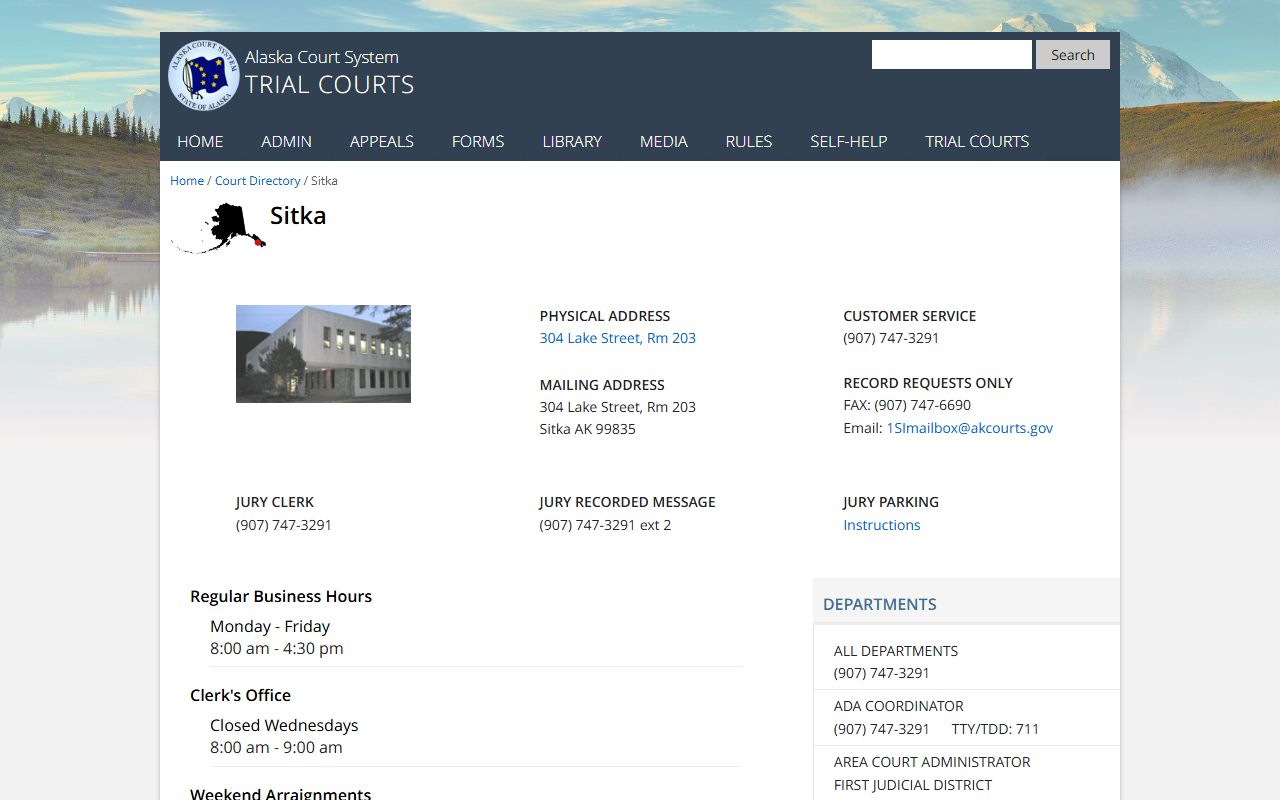
Use that directory view to confirm the room number, contact details, and the 1SI case stream before you send a request or plan a courthouse visit.
How to Search Sitka Traffic Court Records in CourtView
The public search tool at CourtView is designed for case number, party name, and citation searches, which makes it the first stop for most Sitka Traffic Court Records questions. The system returns only non-confidential minor offense matters that have been filed with the court, so not every citation will appear there. That is normal in Alaska. Some tickets are still being processed, some belong to a different payment path, and some never become an open court file because the citation is resolved elsewhere or not yet entered.
For a clean CourtView search, the details you bring matter more than the amount of searching you do. The most useful pieces are the full name exactly as written on the ticket, the citation number, the approximate violation date, and the case number if the clerk has already opened one. CourtView case numbers use the 1SI prefix, a year, and a five-digit sequence with dashes and leading zeroes. The Alaska court system also warns users not to assume the first result is the right person unless they can confirm another identifier such as date of birth.
- Start with the citation number if you still have the ticket.
- Use the 1SI case number exactly as printed when the file is already open.
- Try the full party name before you broaden the search.
- Add the approximate stop or filing date to narrow common names.
- Check the docket and financial tabs if you need status or payment history.
Traffic and minor offense procedure is shaped by Alaska court rules and statutes, which is why the public portal only shows part of the file. The docket is a cumulative record of proceedings, but not every docket entry is a separate document. For that reason, a CourtView result is best treated as a working index, not the final file. If a case is older, sealed, or outside the public display rules, the clerk may still have the paper or retained record even though the portal looks incomplete. The Alaska statutes database at akleg.gov/basis/statutes.asp is useful for reading the rule language behind the traffic process when you need to understand why the record looks the way it does.
Requesting Sitka Traffic Court Records Copies
For copies, Alaska uses the standard TF-311 records request form, which you can find through the court forms page at courts.alaska.gov/forms/index.htm. The records request should go to the clerk where the case was filed, and for Sitka that means the 1SI office at 304 Lake Street, Room 203. You can submit the form by email, fax, or mail through the trial courts process at courts.alaska.gov/trialcourts/, and the office contact details on the court directory tell you where the request should land.
When you fill out the TF-311, the safest approach is to give the clerk enough information to locate the file without extra guessing. A complete case number is the best route, but if you do not have one, the court can still search using a name, a citation number, and a date range. Sitka accepts credit card payments, which is helpful if you need to pay for copies or clear a balance before the office can release what you requested. That payment option sits alongside the normal court payment process, so the clerk can explain whether the matter is a traffic balance, a copy charge, or another court cost tied to the file.
For a practical request, include only the information that will help the clerk reach the correct case on the first pass. A request that names the defendant, the ticket number, and the document type is usually easier to process than a broad inquiry about “all records.” If you need a dismissal, a judgment, a docket sheet, or the file copy that shows how the case ended, say that directly. The traffic record itself is the proof of what happened in court, so the more precise the request, the faster the clerk can find the right document.
The Alaska Court System payment page at courts.alaska.gov/trialcourts/payments.htm explains the general payment framework for traffic fines and court costs. That matters because some people reach the records desk after they discover an unpaid balance, and others need a copy only after they have already paid. In Sitka, the same office can usually help sort out whether you need a case search, a payment answer, or a request for copies. The court directory, the payment page, and the TF-311 form work together, so it is worth keeping them aligned before you send a request.
The City and Borough of Sitka website at cityofsitka.com is a useful municipal reference when you want to separate court records from city administration.
This image helps show the local government setting around the courthouse, but the filed traffic case still belongs with the state court office at 304 Lake Street.
What Sitka Traffic Court Records Show
A Sitka traffic file usually shows more than whether a citation exists. The docket can show the filing date, the charge description, the plea, any hearing settings, the payment history, and the final disposition. If the case involved a fine, bail, or costs, the financial tab may show those entries separately. That is important because minor offense cases are often resolved through a combination of appearance, payment, dismissal, or continuance, and the public search summary does not always tell the whole story without opening the docket.
Not every record is public in the same way. Alaska CourtView excludes confidential and sealed matters, and some case types never appear in the open portal. The court system also notes that there is no comprehensive electronic case information for every trial court location before 1990. Older Sitka matters may still exist in paper indexes, retained files, or archived court records, but they are not guaranteed to appear with the same detail you would expect from a modern search. That is one reason a traffic records request should be precise about dates and document type.
For a person reviewing a file, the most useful details are the ones that answer two basic questions: what happened, and is anything still due? The docket usually answers the first question by showing the hearing history and disposition. The financial entries answer the second question by showing whether the court marked the balance paid, partially paid, or still open. When the record is unclear, the court clerk is usually the best source for confirming whether the file is complete enough for release or whether you need to narrow the request.
Historical Sitka Traffic Court Records and Local Context
Sitka’s records path makes the most sense when you treat the court, the city, and the state rules as separate but related pieces. If the citation was issued recently, the public portal and the clerk can usually tell you whether the file has been opened. If the matter is older, the paper record may be the only complete version. In either case, the court directory at courts.alaska.gov/courtdir/1si.htm is the source that anchors the search to the correct office.
Traffic and minor offense records also sit inside Alaska’s broader rules about public access. The statutes database at akleg.gov/basis/statutes.asp is where you can check the current code language when a filing, payment, or hearing step seems unclear. That is especially helpful when you are reading a docket entry that uses a shorthand term and you want to know whether it reflects a final disposition, a payment, or a future appearance. The rule text does not replace the record, but it helps explain why the record was built the way it was.
Most people searching Sitka Traffic Court Records are trying to prove a case is closed, locate a hearing, or get a copy of the filed document. Those are all records questions, not abstract legal questions, and the fastest answer is usually the most direct one. Start with the 1SI case number if you have it, use CourtView if you need the public docket, and send TF-311 when you need the file itself. That sequence keeps the request aligned with the local office and avoids sending a traffic question to the wrong city desk or a general information line.