
Search Nome Census Area Traffic Court Records
Nome Census Area Traffic Court Records help you find the real court file behind a citation, hearing notice, or old traffic paper. In Nome, the case usually starts at the Nome Superior & District Court, and the best search path runs through CourtView, the directory entry, and the traffic self-help page. That matters because a ticket alone rarely tells the full story. If you know the case number, the citation number, or the name on the notice, you can usually move faster. When the record is what you need, begin with the court record first and let the court file answer the rest.
Nome Traffic Court Records at the Courthouse
The official court contact for Nome Traffic Court Records is the Nome Superior & District Court, 306 W 5th Ave, Nome, AK 99762. The mailing address is PO Box 1110, Nome, AK 99762, and the customer service phone number is (907) 443-5216. The clerk's office is closed daily from 12:00 PM to 1:00 PM and again on Tuesdays from 8:00 AM to 9:00 AM. That schedule is easy to overlook, but it matters if you are trying to get an answer during a narrow break or if you are planning a walk-in request around lunch or a staff meeting window.
Nome case numbers begin with 2NO, which is the quickest way to tell that a traffic file belongs to the Nome court. The same prefix helps when you search CourtView at records.courts.alaska.gov, because the search result tells you whether the case is open, whether a hearing is listed, or whether a record request is the next step. If you already have the citation in hand, use that too. If you only have a party name, the court can still help, but an exact case number usually gets you to the answer faster.
The directory entry at courts.alaska.gov/courtdir/2no.htm is the best place to confirm the office before you call or visit. It also matters that criminal in-custody arraignments are held Monday through Thursday at 1:30 PM, because the court schedule can affect when a file is updated and when a clerk can answer a records question. If you are dealing with a traffic citation that already moved into the court system, the directory and the docket are the two most reliable references, and the clerk mailbox at 2NOmailbox@akcourts.gov is the direct email point for filings and records questions.
The Nome court directory image comes from courts.alaska.gov/courtdir/2no.htm and shows the official courthouse entry for Nome Traffic Court Records.
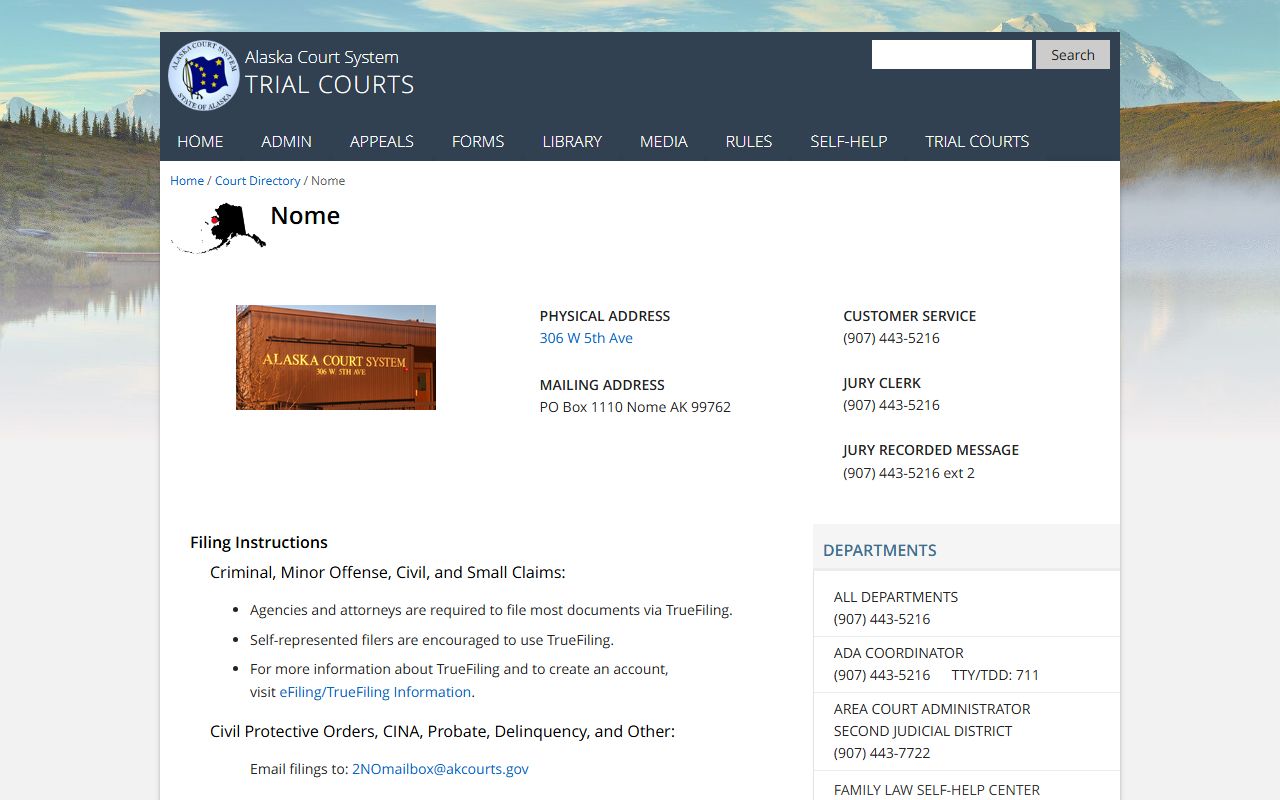
Use that directory to verify the address, phone number, and case prefix before you ask for a traffic file or plan a visit to the clerk's office.
How to Search Nome Traffic Court Records
The search path for Nome Traffic Court Records starts with CourtView and the court directory, then moves to the traffic self-help material when you need to understand what the citation means. CourtView can be searched by case number, party name, or ticket number, so it is useful whether you have the full 2NO number or just a copy of the ticket. That flexibility helps in Nome because a lot of people are working from a paper notice, a phone photo, or a memory of the citation date rather than a perfect file copy.
The traffic self-help page at courts.alaska.gov/shc/mo/index.htm explains the usual response paths for traffic and minor offense cases. That is useful when you are trying to tell the difference between a citation that can be paid, one that needs a response, and one that requires a court appearance. Nome's weekend and holiday arraignments are held at 11:00 AM by telephonic conference using 1-888-788-0099 and Meeting ID 258 955 6006. For people in nearby villages, that remote option is part of the practical search path because the hearing method often appears in the same record trail as the citation itself.
If your search turns up several similar names, stop and compare the date, the case type, and the docket data before you assume you found the right person. CourtView is a case tool, not a guess tool. The docket and the citation details should line up before you rely on the result. When they do, the court file becomes much more useful because it tells you whether the matter is active, paid, closed, or waiting on another filing.
Requests, Copies, and Nome Traffic Court Records
When you need copies of Nome Traffic Court Records, the forms page at courts.alaska.gov/forms/index.htm is the place to start. The standard TF-311 request form is the normal way to ask for a docket sheet, a file copy, or another record from the court. That form keeps the request clean and gives the clerk the details needed to match your request to the 2NO case. It is better to be specific than broad, especially if you already know whether you need a single page, a full docket, or a certified copy.
TrueFiling is required for agencies and attorneys in criminal, minor offense, civil, and small claims matters, so the filing path can matter even in a traffic case that looks simple from the outside. That requirement does not change the public search process, but it does explain why some documents move through the system faster than a mailed request. If you are filing as an agency or as counsel, the court form and the electronic filing process should match the case type before you submit anything, and email filings go to 2NOmailbox@akcourts.gov.
The general trial court page at courts.alaska.gov/trialcourts/ is a useful reference when you are deciding whether your next step is a search, a filing, or a copy request. If you need the legal text behind a citation or a traffic rule, the Alaska Legislature statutes database at akleg.gov/basis/statutes.asp is the official source. Keep those references separate in your mind. The statute tells you the rule, while the court file tells you what happened in the case.
For local context, the City of Nome site at www.nomealaska.org can help you confirm the community setting around the courthouse and other public services. It does not replace the court record, but it helps when you are coordinating a visit, figuring out where the courthouse sits in town, or simply orienting yourself before you contact the clerk. The traffic record remains the main source for the case history.
The City of Nome image comes from www.nomealaska.org and gives local context for Nome Traffic Court Records.
That city context is useful when you are combining the courthouse search with a trip, call, or records request in Nome.
Remote Access and Nome Traffic Court Records
Nome Traffic Court Records are especially important in a region where travel can be hard and weather can change quickly. The court's telephonic options make it possible to deal with a hearing without being in the room, and that same remote approach often helps people keep track of a docket before they ask for copies. The clerk's office can still be the best source for a missing page or a question about a filing, but CourtView gives you the first check without a trip across town or across a village route.
The research notes that surrounding village arraignments can be handled telephonically by emailing 2NOmailbox@akcourts.gov and following the hearing instructions from the court. That is practical because a person in a remote place may need the hearing method to match the record search. If the docket shows a future hearing, the court file becomes more than a status page. It becomes the place where you verify timing, appearance method, and the next required step.
Criminal in-custody arraignments at 1:30 PM on Monday through Thursday are another reminder that Nome's court schedule has rhythm and limits. If you are trying to line up a traffic record with another court event, the day and time matter. The same is true for the clerk's office closure periods. A little timing knowledge can save a call, a wait, and a repeat search. That is one reason Nome Traffic Court Records are easier to use when you begin with the directory and then move to the docket.
Using Nome Traffic Court Records After You Search
Once you have found the case, Nome Traffic Court Records answer the questions that a citation cannot. They show whether the court accepted a response, whether a hearing was set, whether the case was closed, and whether another filing changed the status. That makes the file useful long after the stop itself. People often begin with a ticket number and end up needing a docket history, because the record is what proves what the court received and what it did with the case.
It also helps to keep one note with the case number, the date you contacted the clerk, and the office you reached. Nome is not a place where you want to repeat the same search from scratch every time. If a question comes back later, those notes help you reconstruct the record trail. They also make it easier to tell whether you are missing a filing, a payment entry, or a hearing notice, which is often the real issue behind a traffic records request.
For most users, the best pattern is simple. Start with CourtView, confirm the 2NO case if it exists, check the directory for current contact details, and then use the forms page when you need copies. That sequence keeps the request grounded in the official court file and avoids guessing based on memory or a stale paper notice. Nome Traffic Court Records are most useful when the record, the directory, and the request method all match the same case.