
Juneau Traffic Court Records Lookup
Juneau Traffic Court Records help you find state traffic cases, minor offense citations, and older paper files tied to the First Judicial District. If you are trying to search a case by name, citation number, or case number, the Juneau court and related record offices give you several ways to narrow the search and get copies. This page explains where those records are kept, how CourtView works, when the clerk is open, and what to do if you need a current docket, a payment status check, or a historical file that is no longer on the public portal.
Juneau Records Snapshot
Where Juneau Traffic Court Records Start
The main court location for Juneau traffic matters is the Juneau Trial Courts in the First Judicial District. The clerk’s office is at 123 4th Street, Juneau, AK 99811, with mail sent to Box 114100, Juneau, AK 99811. You can reach customer service at (907) 463-4700, send records fax requests to (907) 463-3788, or email 1JUmailbox@akcourts.gov. Regular hours are Monday through Friday, 8:00 AM to 4:30 PM, and the clerk closes Thursdays from 8:00 AM to 9:00 AM for a staff meeting.
Juneau’s traffic and minor offense cases use the CourtView system for public searching. Case numbers begin with the 1JU location prefix, and the clerk can search by party name, case number, or citation number. The public portal is designed for current case access, but it is not a full archive of everything ever filed. That matters in Juneau because some traffic tickets are entered quickly, some are handled through city channels, and some older records live in paper files rather than on the online screen.
The clerk also hosts weekend and holiday arraignments at 10:30 AM by telephone. If you need to follow a live traffic case, the public access line is 1-888-788-0099 and the meeting ID is 923 853 3061. That access point is useful when a citation requires a court appearance and you want to know whether the hearing is still on the calendar.
| Office | Juneau Trial Courts, First Judicial District |
|---|---|
| Address | 123 4th Street, Juneau, AK 99811 |
| Mailing Address | Box 114100, Juneau, AK 99811 |
| Phone | (907) 463-4700 |
| 1JUmailbox@akcourts.gov |
See the Juneau court directory on the Alaska Court System site for the basic office listing tied to local traffic filings.
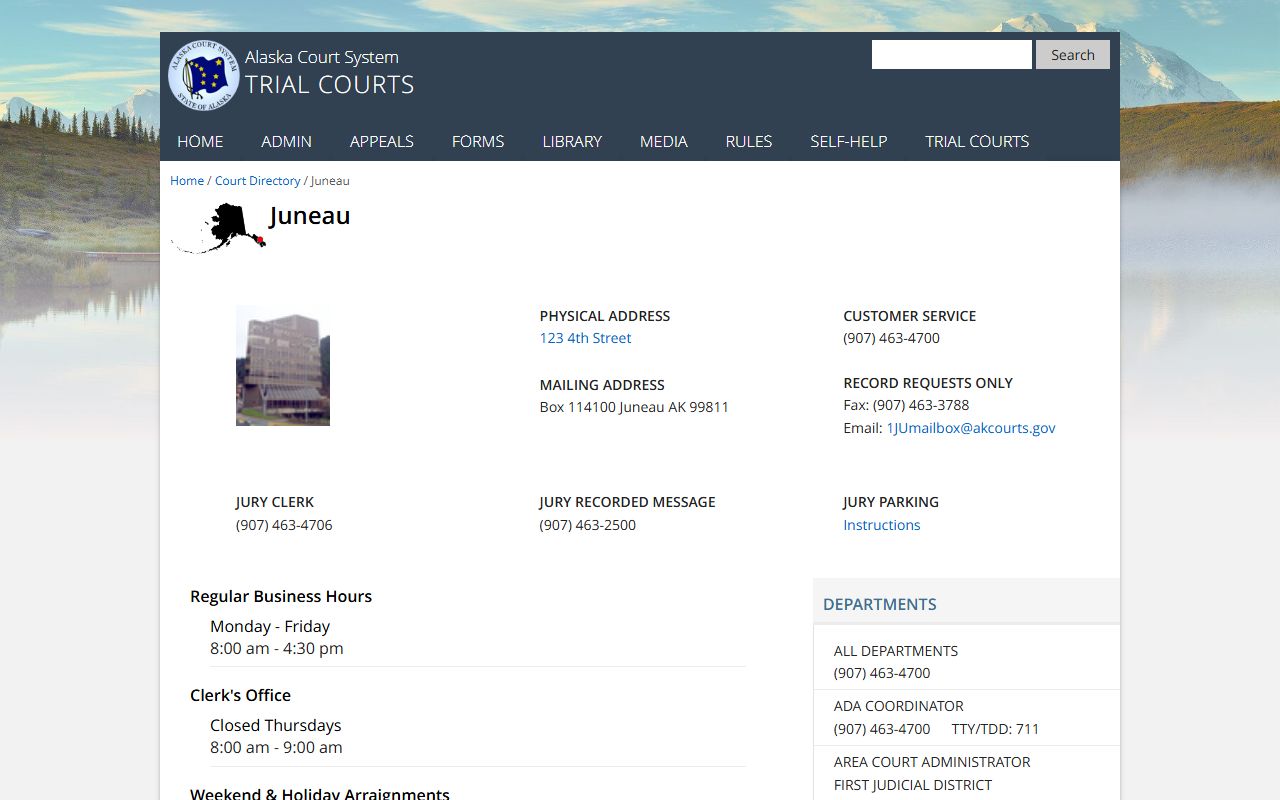
This directory view helps connect a case search to the correct First Judicial District office before you request copies or ask about a docket.
Searching Juneau Traffic Court Records in CourtView
The fastest way to look up a Juneau traffic case is through CourtView. The search tool accepts a case number, party name, or citation number. For case-number searches, use the full format with the 1JU prefix, the year, and the sequence number with leading zeroes. For example, a traffic case may look like 1JU-24-01234MO. The MO suffix signals a minor offense file, which is the usual label for many traffic matters.
CourtView is useful because it shows the basic public docket, charge information, and financial activity without requiring a trip to the courthouse. It also reflects Alaska’s public-record limits and the rules that keep some case types confidential. The current Alaska statute index is available at akleg.gov. The portal does not show every citation that an officer writes, and it does not show every part of a case file. If a citation is not in the system yet, the clerk may still be processing it. That is why the court system warns users not to assume a mismatch means the person or citation is missing.
When you search Juneau Traffic Court Records, it helps to have a few details ready:
- The defendant’s full name, spelled as it appears on the ticket
- The citation number from the paper ticket, if you have it
- The approximate violation date or filing date
- The 1JU case number, including the dashes and zeroes
- A second search term in case the ticket uses a middle initial or nickname
Minor offense and traffic procedure is shaped by Alaska statutes and court rules, which is why the public portal excludes some confidential matters and why charge dispositions must be read carefully. A docket entry can show a hearing, a payment, a continuance, or a dismissal, but it does not always tell the whole story in one line. If the case is older, or if the citation was handled outside the standard filing flow, the clerk may be the better source for confirmation than the online search screen alone.
Requesting Juneau Traffic Court Records by Form
For copies, the court uses the standard Alaska TF-311 records request form. That form is meant for requesting court records from the clerk where the case was filed, and Juneau is one of the offices that accepts those requests directly. If you send a complete case number, the clerk can usually move faster and avoid extra research time. If the request needs staff to search without a full case number, the form should still include as much identifying information as possible so the office can locate the right file.
The Juneau clerk accepts in-person, mail, fax, and email requests. In-person requests go to 123 4th Street during business hours. Mail goes to Box 114100. Fax goes to (907) 463-3788, and email goes to 1JUmailbox@akcourts.gov. The clerk can provide plain copies, certified copies, or exemplified copies depending on what you need. Juneau also accepts credit card payments, which matters when you are asking for copies and need to resolve the payment at the same time.
Most users ask for one of a few common document types, such as the charging document, a judgment, a dismissal, the final order, or the docket sheet. A traffic case may also contain a payment history, a plea, a fine amount, or notes about license-related consequences. Those details are often enough for a person trying to prove that a ticket was resolved, but they are also useful when you are checking whether a citation turned into a court case, a payment problem, or a missed hearing.
The court system’s payment guidance is also relevant if your search turns up an open balance. The Alaska Court System’s payment page at courts.alaska.gov/trialcourts/payments.htm explains the general methods for paying traffic fines, and Juneau is among the courts authorized to accept credit cards. If a citation is marked for a city payment path instead of the court, that is a separate process and the clerk can tell you whether the citation belongs there or in the state case file.
What Juneau Traffic Court Records Usually Show
Juneau traffic case files usually contain more than the public search summary. The docket can show when the ticket was filed, when the defendant appeared, whether a plea was entered, and whether the case ended in a conviction, dismissal, deferral, or payment plan. The file may also include the citation number, the officer’s name, the violation description, and the amount of any fine or surcharge. That combination makes the record useful for confirming how a case moved through the court even if a person only starts with a ticket stub or a partial case number.
In Alaska, not all minor offense cases are public in the same way. CourtView generally focuses on non-confidential matters, and some records remain outside the online system because they are sealed, confidential, or otherwise excluded by law or rule. That is why a search result should be treated as a lead rather than the final word. If the goal is to understand a live traffic matter, the docket and hearing schedule matter. If the goal is to document a resolved matter, the final disposition and payment history matter more.
For a practical records review, the most useful fields are often the case number, the filing date, the charge description, the disposition, the financial tab, and any notes about future hearings. If you are checking whether a matter was resolved, those entries usually tell you whether the court still expects action. If you are trying to verify an older citation, the paper file or the archived record may be the only place that still holds the full history.
Juneau’s city view on juneau.org helps show how the borough government and the court system sit close together even though they serve different record functions.
This image is a useful reminder that a traffic citation can touch both court records and city-side administrative offices, depending on how the ticket was issued and where it was routed.
Historical Juneau Traffic Court Records and Archives
If you need an older case that predates the CourtView era, the Alaska State Archives is the place to start. The archives are at 395 Whittier Street in Juneau and are especially helpful for historical court material that is not easy to find online. CourtView does not provide a complete digital back catalog for every trial court location, so older traffic files often need a manual search through paper indexes, archived docket material, or the clerk’s retained records.
That distinction matters in Juneau because people often assume that every old citation should appear online. In reality, a historical search can mean working backward from a name, a year, or a partial ticket number. The archived material may not look like a modern electronic case summary. It may instead be a paper index card, a docket note, or a scanned file that takes extra time to locate. When that happens, the best approach is to identify the court location, the approximate year, and any citation details you still have before you submit a records request.
Alaska public-record limits and traffic-case rules also shape what can be released. Some matters are not available through the open system at all, and some older files may require proof of identity or a more specific request. That is one reason the court system offers formal request forms and why the archives remain important for record history that extends beyond the regular online search window. If your goal is to confirm whether a Juneau citation ended up in court, the combination of CourtView, the clerk, and the archives usually gives the clearest answer.