
Search Copper River Traffic Court Records
Copper River Census Area Traffic Court Records usually begin at the Glennallen District Court, because that office is the starting point for traffic citations, docket updates, and copy requests tied to the Glenn Highway corridor. If you are trying to find a ticket, check whether a case is open, or obtain a record for your own files, the fastest route is to start with the Alaska Court System directory and then move into CourtView. The case prefix, the courthouse address, and the records request form all work together. That combination helps you locate the right file without guessing which office has the record or which court should answer the question.
Copper River Traffic Court Records Snapshot
The Glennallen District Court is the practical center for Copper River Traffic Court Records. It sits at Mile 188.5 Glenn Highway, Glennallen, AK 99588, with mailing address P.O. Box 86, Glennallen, AK 99588. The clerk’s phone number is (907) 822-3405, the fax number is (907) 822-5364, and the records email is 3GLMailbox@akcourts.gov. The clerk is closed daily from 12:00 PM to 1:00 PM. Those details matter when you are planning a call, a visit, or a written request, because the best public search still has to end at the office that actually holds the file.
| Court | Glennallen District Court, Third Judicial District |
|---|---|
| Address |
Mile 188.5 Glenn Highway Glennallen, AK 99588 |
| Mailing Address | P.O. Box 86, Glennallen, AK 99588 |
| Phone | (907) 822-3405 |
| Fax | (907) 822-5364 |
| 3GLMailbox@akcourts.gov | |
| Case Prefix | 3GL |
| Nearest Superior Court | Palmer Superior Court, 435 South Denali Street, Palmer, AK 99645, (907) 746-8181 |
| Online Search | records.courts.alaska.gov |
The official directory page at courts.alaska.gov/courtdir/3gl.htm is the best place to confirm the Glennallen contact details before you travel or mail a request. The nearby superior court in Palmer is listed at courts.alaska.gov/courtdir/3pa.htm, which is useful when a traffic matter needs broader trial court context. For routine searches, those two directory pages give you the cleanest route from a citation to the correct court office.
The Glennallen court directory image comes from courts.alaska.gov/courtdir/3gl.htm and shows the district court that anchors Copper River Traffic Court Records.
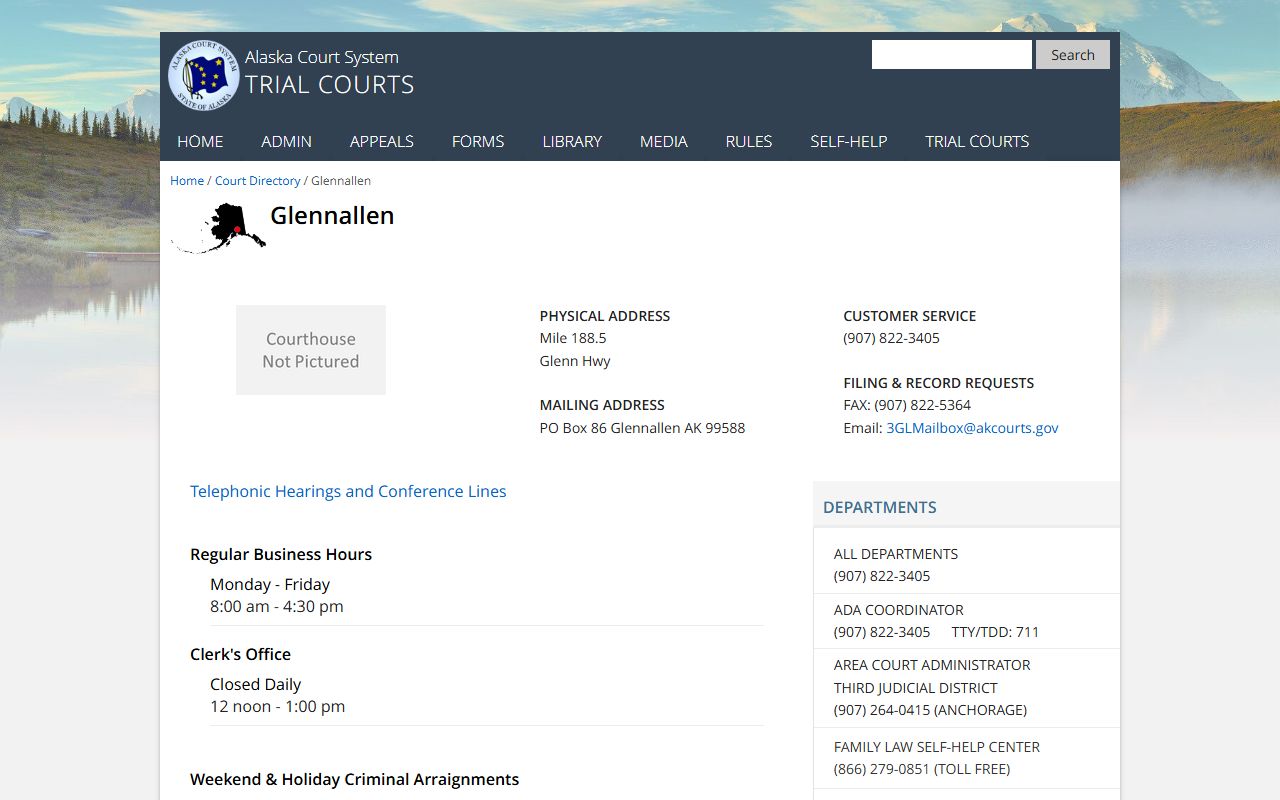
Use that directory entry to verify the office location, the clerk contact path, and the midday closure before you call, visit, or send a records request.
Where Copper River Traffic Court Records Begin
Copper River Traffic Court Records begin in the district court system, not in a local office that only handles informal questions. That matters because a traffic citation issued along the Glenn Highway can still belong to the Glennallen court even if the place name on the citation seems unfamiliar. The 3GL prefix is the quickest way to confirm that you are looking at the right docket in CourtView. If you already have a case number, use it first. If you only have the citation number or the driver name, the public search portal can still narrow the record before you contact the clerk.
The Alaska Court System traffic self-help page at courts.alaska.gov/shc/mo/index.htm is useful when the file is tied to an active citation. It explains the traffic response path, which helps you understand whether the record should show a hearing, a payment, or another case action. The statewide trial courts page at courts.alaska.gov/trialcourts/ is also a good reference because it places the district court inside the larger Alaska court structure. That is the right context when you are trying to separate a records search from a broader court question.
For Copper River Traffic Court Records, the main point is to match the case to the correct court before you ask for copies. A request that starts with the wrong office can add delays, while a request that includes the prefix, citation number, and court directory reference usually moves faster. Glennallen is the first stop, and Palmer becomes relevant only when you need the nearest superior court for a separate procedural step or a broader judicial reference.
Searching Copper River Traffic Court Records in CourtView
CourtView at records.courts.alaska.gov is the best public tool for searching Copper River Traffic Court Records because it lets you search by name, citation number, or case number. That flexibility is helpful in a remote area where you may only have part of the information from a ticket or a notice. A search result can confirm whether the case exists, whether it is active, and whether the court has already posted a recent docket entry. If the result begins with 3GL, the file is tied to Glennallen.
The portal is not a substitute for the complete court file, but it is the fastest way to make sure you are asking about the right case. It is especially useful before you call the clerk or send a TF-311 request, because it can eliminate obvious mismatches early. A name search may show more than one result, so the citation number or case number is always the better identifier when you have it. If you do not have it, the combination of driver name, approximate date, and citation location is usually enough to narrow the search to the correct docket.
When you are using CourtView for Copper River Traffic Court Records, keep in mind that the public entry may only show the most recent event. A payment, continuance, hearing setting, or disposition note can appear before the underlying documents do. That is normal. The search tells you where the record is. The clerk’s office tells you how to obtain the file itself. Together, those two steps keep the process organized and reduce the chance that you will request the wrong case or the wrong document type.
Requesting Copper River Traffic Court Records Copies
When you need an actual copy of Copper River Traffic Court Records, use the Alaska Court System forms page at courts.alaska.gov/forms/index.htm and look for the TF-311 request form. That is the standard path for asking for a case file, a docket sheet, or a copy of a document tied to a traffic matter. The form gives the court a clear, repeatable way to route your request, which is important when the file has to be pulled from a district court office rather than from a general records inbox. If you already know the 3GL case number, include it at the top of the request.
If you do not have the case number, include the citation number, the full name on the notice, the citation date, and any hearing date you can confirm from your paperwork or from CourtView. That information helps the clerk find the right file on the first pass. For Copper River Traffic Court Records, the goal is not to write a long explanation. It is to make the record easy to locate. A short, specific request is usually more effective than a broad request that forces the office to guess which citation you mean.
The self-help page and the forms page work well together. The traffic self-help guide helps you understand what happened in the case, while the TF-311 form is the practical tool for getting the underlying file. If your matter turns on a current citation or a deadline that appears in the docket, check the self-help page before you request copies. If the only thing you need is the filed record, the request form is usually enough to move the process forward without extra back-and-forth.
What Copper River Traffic Court Records Can Show
A public search result gives you a quick status check, but the full file can show the documents that explain how the case moved through the court. For Copper River Traffic Court Records, that difference matters. The docket may tell you that something happened, but the case file shows what was filed, when it was filed, and how the court treated the citation. That is useful when you are trying to confirm a final disposition, compare the filed record to your own paperwork, or understand why a case appears in CourtView the way it does.
Common items found in a traffic file include the citation details, hearing entries, appearance notes, payment or disposition information, and any filed document tied to the case. Some files also include references to recordings or other procedural notes. Not every item will be visible in the public portal, and not every document is equally easy to obtain without a formal request. That is why the search and request steps work best as a pair. One identifies the file, and the other gets you the documents behind it.
The following items are often the most useful when you are reviewing Copper River Traffic Court Records:
- Case number, citation number, and party name
- Hearing dates, continuances, and appearance notes
- Payment entries, dismissals, or disposition information
- Filed documents connected to the citation
- References to recordings or other procedural notes
If a docket entry leaves you with a question about the current rule or procedure, the Alaska Legislature statutes database at www.akleg.gov/basis/statutes.asp is the official place to check the current text. That page is helpful for context, but it does not replace the court file. The file shows what happened in the case, while the statutes page helps explain the rule that governs the traffic matter. Used together, they give you a more complete picture without turning the search into a law summary.
Related Courts and Next Steps
If your search leads beyond Glennallen, the nearest superior court in Palmer may become relevant for broader trial court questions. The Palmer directory at courts.alaska.gov/courtdir/3pa.htm gives you the official location and phone number for that office, which is useful when you are trying to understand where a related filing or a procedural question belongs. For ordinary traffic matters, though, the district court in Glennallen remains the place where the record starts and where the copy request should go first.
The statewide trial courts page at courts.alaska.gov/trialcourts/, the traffic self-help page at courts.alaska.gov/shc/mo/index.htm, the forms index at courts.alaska.gov/forms/index.htm, and CourtView at records.courts.alaska.gov are the four official tools that keep a Copper River Traffic Court Records search on track. If you use them in that order, you usually move from search to request without losing the case number, the clerk contact, or the procedural context that explains the docket.