
Find Palmer Traffic Court Records
Palmer Traffic Court Records are searched through the Palmer Superior & District Court at 435 South Denali Street, Palmer, AK 99645. That court serves the Mat-Su Valley, so a traffic stop in Palmer, Wasilla, or another nearby borough community usually points back to the same court file. If you need a citation check, a docket entry, or a copy of the record, start with the Palmer court directory, CourtView, and the records request form. That order helps you see where the case sits and which office can give you the fastest answer.
Palmer Traffic Court Records and the Courthouse
The main court for Palmer traffic matters is the Palmer Superior & District Court, and it is the office that keeps the case file when a citation has moved into the Alaska Court System. Customer service is (907) 746-8181, records requests go to 3PACopyRequests@akcourts.gov, and fax requests go to (907) 746-8152. The clerk's office is closed Wednesdays from 8:00 AM to 9:00 AM for staff meetings, so it is worth checking the clock before you walk in or call. The court directory at courts.alaska.gov/courtdir/3pa.htm is the cleanest first stop for those details.
Palmer matters matter beyond city limits. The court serves the broader Mat-Su Valley, which means the same file room can handle records tied to Palmer, Wasilla, and nearby unincorporated places in the borough. That is why a local traffic search is best handled as a court search, not just a city search. The city can still hold local police or municipal records, but the docket, filing history, and copy request route are in Palmer. If you want the official record of what happened in court, this is the office that matters most.
Palmer case numbers begin with 3PA, and that prefix helps the CourtView search line up the right file quickly. It also keeps a simple traffic search from drifting into other Alaska courts. When you already know the court code, the clerk can move faster, and the portal is less likely to return a mixed list of cases with the same name. That small detail makes a real difference when you are trying to pull a citation, a hearing date, or a final disposition without wasting time on the wrong record.
The official Palmer court directory image below comes from the Palmer court directory.
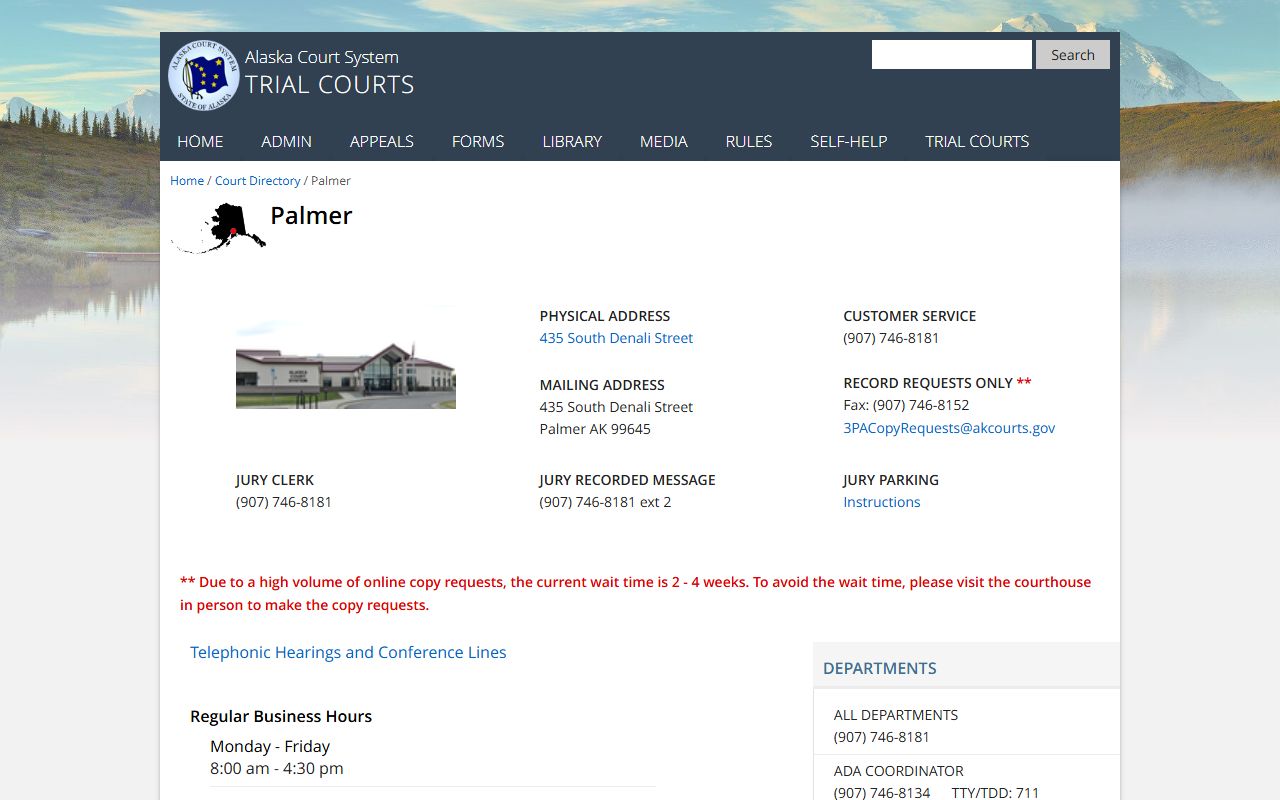
Use it as the best quick reference for the courthouse address, request route, and contact numbers tied to Palmer Traffic Court Records.
How to Search Palmer Traffic Court Records
The fastest public search starts with CourtView at records.courts.alaska.gov. Palmer Traffic Court Records can be searched by name, citation number, case number, or hearing date, and the court prefix 3PA helps you narrow the result set right away. If you already have the ticket number, use it first. If you only have a name, add the approximate year or the citation date so the search does not drift into a long list of unrelated files. A tight search is faster for you and for the clerk.
The traffic and minor offense guidance at courts.alaska.gov/shc/mo/index.htm is the right place to review the basic path after a citation is issued. It explains the public court process in plain terms and helps you tell whether you are looking for a file, a response deadline, or a payment question. If the citation refers to a rule or code and you want the official wording, the Alaska statutes database at akleg.gov/basis/statutes.asp gives you that source text without forcing you to rely on a summary page.
A good search is usually a short search. Start with the court code, then the name, then the citation details. That order keeps the result set clean. It also helps you decide whether the record is already in the public portal or whether you need to move straight to a records request. For Palmer, that distinction matters because the online summary is useful, but the official file is still the source you want when the question is about what the court actually entered.
Request Copies of Palmer Court Files
If you need copies, the Palmer-specific request form is TF-311 PA. The form is linked from the statewide forms page at courts.alaska.gov/forms/index.htm and the direct Palmer PDF at public.courts.alaska.gov/web/forms/docs/tf-311pal.pdf. That form is the right one for written records requests because it matches the Palmer court workflow instead of a generic statewide form. You can send requests by email, fax, mail, or in person, but the court still needs the basic case details to pull the right file.
Email and online requests usually take two to four weeks. In-person requests with a case number are often handled right away, which makes a courthouse visit the faster choice when you already know the file you want. If the clerk has to search without a case number, the work can slow down and the request can move from a simple copy job into a research request. That is why the citation number, the case number, and the full name on the ticket are all worth collecting before you send anything.
Palmer also uses the TF-304 PA audio request path for hearing recordings, and the forms page is the best official place to reach it. A written docket copy and a hearing recording are not the same thing, so it helps to decide which one you need before you ask. If you only want the final disposition, a certified paper copy may be enough. If you want to hear the hearing itself, the audio request is the better route. Using the right request from the start saves time for both sides.
TrueFiling for Palmer Court Filings
TrueFiling at courts.alaska.gov/efiling/truefiling.htm matters when a Palmer traffic matter needs to be filed instead of merely requested. The system is available for civil, small claims, and minor offense cases, and the research notes make clear that agencies and attorneys are required to use it for most filings. Self-represented filers are encouraged to use it as well, which helps keep the case file current when a response, motion, or related paper has to go into the court record.
That filing path is useful because it keeps the record in one place. A traffic case can start as a citation, move into a hearing, and then need a later filing or response. When that happens, the court file does not sit in a city office or a police file cabinet. It stays in the court system, and TrueFiling is the channel that matches that workflow. If you are trying to keep a clean paper trail, the electronic filing page is the right place to confirm what the court expects before you send anything else.
Palmer City and Borough Records
The City of Palmer provides municipal services, and the city hall address is also 435 S. Denali St., Palmer, AK 99645. The Palmer Police Department maintains city law-enforcement records, so the city can still matter when you need a local report, a municipal contact, or a police-side record tied to the same stop. The city site at www.cityofpalmer.org is the official local point of reference when you need that municipal side of the picture.
The borough site at www.matsugov.us is another useful local resource because Palmer sits at the center of Matanuska-Susitna Borough. That borough context helps explain why Palmer Traffic Court Records are not just a city issue. They serve a wider area, and the court handles traffic matters for people across the valley. If you are trying to match a stop to the right office, keep the split in mind: municipal records can live with the city, while the filed traffic case lives with the court.
That split is the main reason Palmer searches go faster when they stay focused on the court file. A city office can help with city records, but the docket, hearing history, and copy request path still belong with the Palmer court. Once you know that, the rest of the search gets simpler. You can stop guessing, narrow the office list, and ask the place that actually holds the record you need.
What Palmer Traffic Court Records Show
Palmer Traffic Court Records can show the citation number, the case number, hearing dates, docket entries, payment activity, and the final result of the matter. That is useful if you need to confirm what happened after the ticket was issued. A public search can tell you the current status, but the file itself is what you want when you need a paper record you can keep or certify. For a lot of users, that is the cleanest way to settle a timeline question without asking a second office to explain the case.
Those records can also help you tell the difference between a traffic stop, a court filing, and a city-side police record. They can touch the same event, but they do not serve the same purpose. If you need the official court action, Palmer is the office to use. If you need a city report, the police department or city office can help with that separate record. Keeping those lines clear is the easiest way to avoid sending the wrong request to the wrong desk.
When you have the case code, the clerk can usually move faster, and CourtView can usually return a cleaner result. When you do not have the code, the records request form still works, but the search takes more time. That is why the best Palmer approach is simple: search the portal, confirm the case, choose the right form, and then ask for only the copy or audio you actually need.