
Search Knik-Fairview Traffic Court Records
Knik-Fairview is a census designated place in Matanuska-Susitna Borough, and Knik-Fairview Traffic Court Records are searched through Palmer rather than through a separate city courthouse. That matters when you need a citation, a docket line, a hearing date, or a copy of a traffic file. Start with the Palmer court directory, CourtView, and the TF-311 PA request path so you are working with the office that actually holds the case. The Knik-Fairview search also fits the wider Mat-Su pattern, which helps when the ticket came from a road near Wasilla or Palmer and the paperwork is still in the Palmer file room.
Why Knik-Fairview Traffic Court Records Route Through Palmer
The Palmer Superior & District Court at 435 South Denali Street, Palmer, AK 99645 is the court that serves Knik-Fairview. Customer Service is (907) 746-8181, and the records email is 3PACopyRequests@akcourts.gov. Those details matter because a Knik-Fairview ticket does not point to a separate city courthouse. It points to Palmer, where the court file, the docket, and the copy request all live. If you start with the wrong office, you waste time. If you start with Palmer, you are already close to the record.
The Palmer court directory at courts.alaska.gov/courtdir/3pa.htm confirms the courthouse contact path, and CourtView at records.courts.alaska.gov gives you the first public search pass. For Knik-Fairview, the 3PA case prefix is a strong clue that the file belongs in Palmer and not in a city office. That prefix is useful when you search by name, citation, or case number, because it keeps the result tied to the same Mat-Su court that handles the traffic matter.
If you want the portal rules in one place, the CourtView information page at courts.alaska.gov/trialcourts/cvinfo.htm explains how the public search works and what it can show. That helps when you want to compare a docket summary with the direct records portal and the Palmer directory. The two pages work better together than apart, especially when you are trying to tell whether a traffic case is active or already resolved.
The borough site at www.matsugov.us helps with local context, but it does not replace the court file. A borough page can tell you about the place. Palmer tells you about the traffic case. When you are trying to obtain a record, that split is the first thing to keep straight.
The Palmer court directory image below comes from the official Palmer court directory.
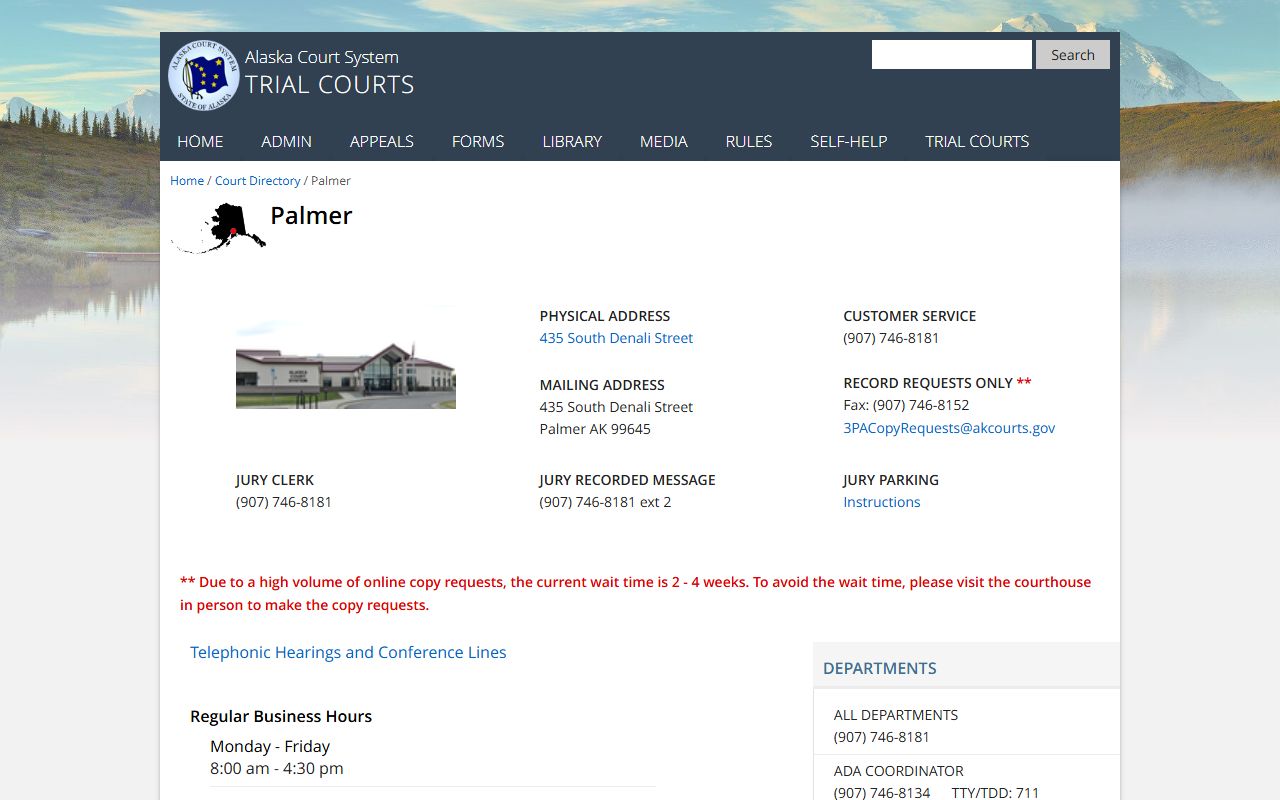
Use that directory when you want the direct courthouse contact path for a Knik-Fairview traffic search or a record copy request.
How to Search Knik-Fairview Traffic Court Records
Search Knik-Fairview Traffic Court Records by citation number, case number, or full name. Those three details usually take you farther than a broad place search, because CourtView is built around court data, not neighborhood memory. If you have the 3PA case number, even better. That tells you the case is in the Palmer system and lets the clerk or online portal narrow the result fast. The public search result may show the docket, the charge, the hearing date, or the current status, which is enough for an initial check.
The traffic self-help page at courts.alaska.gov/shc/mo/index.htm explains how Alaska traffic citations are handled and what kind of response a citation may need. That page is useful when you are trying to decide whether you need to search, pay, contest, or request a copy. The statewide trial courts page at courts.alaska.gov/trialcourts/ gives the broader records-request path, while the forms page at courts.alaska.gov/forms/index.htm points you to the forms that belong with the file. Together, they tell you where the record lives and how to ask for it.
When you search, keep the key details together so you do not slow yourself down:
- Citation number from the ticket or notice
- 3PA case number if the file is already open
- Full name exactly as shown on the citation
- Date or month when the stop or citation happened
If the search is thin, the self-help page and the court directory still help because they show the right office, the right form path, and the right case prefix. That is often enough to get from a vague question to the actual traffic record without guessing at the wrong office.
Request Copies of Knik-Fairview Traffic Court Records
If you need the actual file, use TF-311 PA from the forms page at public.courts.alaska.gov/web/forms/docs/tf-311pal.pdf. That form is the right request form for Palmer Trial Court, which is the court that serves Knik-Fairview. Requests can be made in person, by email, fax, or mail, and the court directory confirms the contact information you need before you send the request. The Palmer records email is 3PACopyRequests@akcourts.gov, and the fax number is part of the same directory page.
The request method matters because the timing changes. Palmer online or email requests are usually handled in two to four weeks, while in-person requests with a case number can be processed immediately. If the clerk has to search without a case number, a research fee may apply. Standard copies, certified copies, and research all follow the statewide trial court schedule, so it helps to know whether you want a plain copy, a certified copy, or just a docket check. The payment page at courts.alaska.gov/trialcourts/payments.htm is useful when a payment or balance is part of the same case review.
The trial courts records page at courts.alaska.gov/trialcourts/index.htm explains the request route in one place and is useful when you want to compare Palmer with the rest of Alaska. If you are only trying to confirm that a citation was resolved, a docket sheet may be enough. If you need a certified copy for a file, the request form and the court directory are the two things that keep the process clean and direct.
TrueFiling at courts.alaska.gov/efiling/truefiling.htm matters if the traffic matter turns into a filing instead of a simple copy request. That keeps the page tied to the actual court workflow and gives you one more official route when a record search leads to a document that still has to be filed.
Note: A case number makes the Palmer request faster, while a blank request can turn into research time before the clerk can release the record.
Knik-Fairview Traffic Court Records and Mat-Su Context
Knik-Fairview is not an incorporated city, so local context comes from the borough and the surrounding Mat-Su communities rather than from a city hall record stack. That is why the borough site at www.matsugov.us belongs in the search path. It gives place context, community information, and borough-level reference points. It does not replace the court record, but it helps you understand the local map around the citation.
For a Knik-Fairview traffic search, the best habit is to separate place from court. The place may be Knik-Fairview, but the court is Palmer. The place may be near Wasilla, but the case file is still in the Palmer system. That is the logic behind CourtView, the court directory, the records request form, and the traffic self-help page all working together. Each one answers a different question, and together they move you from location to record.
That same split also keeps the search focused when a ticket refers to a road, a borough route, or a stop near Palmer. You can use the Mat-Su site for local context, the court directory for the clerk path, and CourtView for the public case check. Once you know which office is holding the file, you are much closer to the record you want.
Traffic Rules and Forms for Knik-Fairview Traffic Court Records
The traffic self-help page at courts.alaska.gov/shc/mo/index.htm and the Alaska statutes database at akleg.gov/basis/statutes.asp are the two official places to check when a citation refers to a rule or offense code. Alaska traffic matters often turn on AS 28.35.030, AS 28.35.031, AS 28.35.032, AS 28.35.400, or AS 28.35.410. Those codes help you understand the citation, while CourtView and the court directory help you find the file. The two tasks are related, but they are not the same.
The forms page at courts.alaska.gov/forms/index.htm is where the broader court forms live, and that is useful when a traffic matter needs more than a simple status check. If you need the file itself, TF-311 PA is the form that belongs in the request. If you only need to know what the citation means, the self-help page and the statute page do more of the work. If you need the actual case history, the Palmer record does that job.
Knik-Fairview Traffic Court Records become much easier to manage once you keep those roles separate. The statute page explains the rule, the traffic page explains the response, and the records path gives you the case. That order keeps the search practical and keeps you from asking the court to solve a question that belongs on a different page.