
Find Kenai Traffic Court Records
Kenai Traffic Court Records are usually found at the regional state courthouse in Kenai rather than in a separate city-only file room. That matters because a Kenai traffic ticket can start as a city matter, move into the Alaska Court System, or remain payable directly to the city depending on how the citation was written and where it landed in the process. If you are searching for a citation, a case number, a docket entry, or a copy of the paper file, start with the Kenai courthouse at Trading Bay Drive and then use CourtView, the TF-311 request path, and the city website as needed. That sequence keeps you focused on the office that actually holds the record.
Kenai Traffic Court Records and the Regional State Courthouse
The main court for Kenai traffic matters is the Kenai Superior & District Court at 125 Trading Bay Drive, Suite 100, Kenai, AK 99611. Customer Service is (907) 283-3110, records fax requests go to (907) 283-8535, and records email goes to 3KNmailbox@akcourts.gov. The clerk’s office is open Monday through Friday from 8:00 AM to 4:30 PM, but it closes Thursdays from 8:00 AM to 9:00 AM and Fridays from 12:00 PM to 1:00 PM. That schedule is worth checking before you drive over, because the courthouse is the regional center for the city and for much of the central Kenai Peninsula.
Kenai city traffic records are mainly held in this state court, even though some city tickets may be payable directly to the city. That split is important. If the ticket tells you to pay the city, the city may be the right place for payment. If you need the filed case, the hearing record, or a docket summary, the state court is usually the better source. Kenai Police Department maintains local law enforcement records for city matters, but the city’s public website is the safer starting point for routing a question than guessing at a record location or assuming every citation stays in one office.
The court is also part of the Third Judicial District, and Kenai case numbers begin with 3KN. That prefix makes CourtView searches much faster because it immediately separates Kenai filings from other Alaska trial court records. The Kenai court also offers a Joint-Jurisdiction Wellness Court program, which can matter if a traffic matter is part of a broader treatment-focused case path. Even then, the basic search process remains the same: identify the case, confirm the office, and then request the copy or status you actually need.
The Kenai court directory image comes from courts.alaska.gov/courtdir/3kn.htm and is the best visual reference for Kenai Traffic Court Records at the regional courthouse.
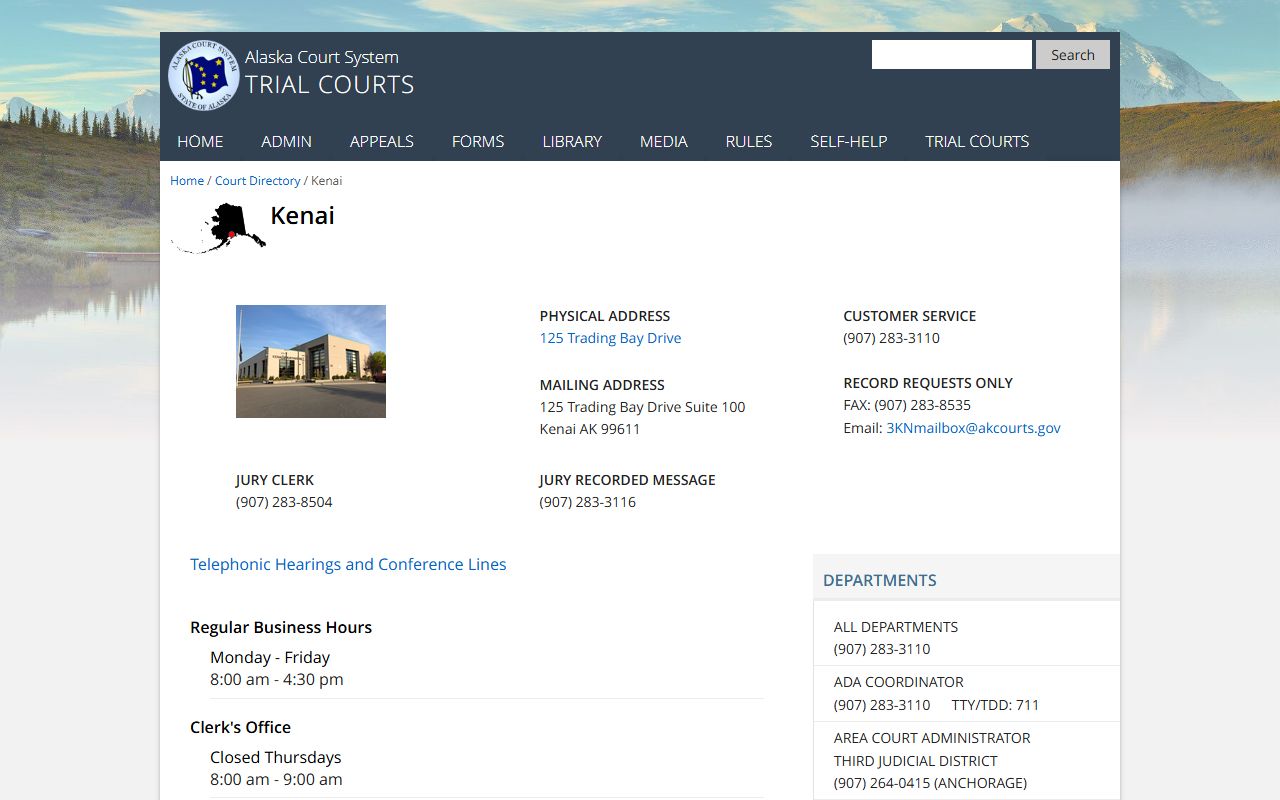
Use that directory to confirm the courthouse contact details before you call, write, or visit for a records request.
How to Search Kenai Traffic Court Records in CourtView
CourtView at records.courts.alaska.gov is the fastest way to search Kenai Traffic Court Records when you have a name, citation number, or case number. The search tool is designed for quick status checks, so it is the first place to confirm whether a citation has been filed, whether a docket entry already exists, or whether the matter is still pending. If you already have the case number, the 3KN prefix tells you that the file belongs to Kenai, and that is often enough for the clerk to find the right record without additional searching.
Search results usually show the public docket, charge information, and key dates, which is enough to tell you whether the record is active, resolved, or waiting for the next filing step. A simple name search can also work, but a citation number or case number is better when you want to avoid false matches. If the case is a city ticket that may still be payable directly to the city, the court search can still help you see whether a case file exists in the state system or whether the matter has stayed on a separate municipal path.
The current traffic and minor offense guidance at courts.alaska.gov/shc/mo/index.htm is useful when you are trying to understand what kind of response a citation requires. It explains the basic traffic response framework and helps you tell the difference between a simple payment issue and a filing that needs more attention. The current Alaska statutes database at akleg.gov/basis/statutes.asp can also help you confirm the code language if the citation refers to a specific rule. In practice, CourtView gives you the case, and the statutes page gives you the legal context behind the case.
Requesting Copies of Kenai Traffic Court Records
If you need paper copies or certified copies, the Alaska Court System forms page at courts.alaska.gov/forms/index.htm is where the standard TF-311 records request form lives. That form is the normal way to ask for a docket sheet, a judgment, a final disposition, or other documents from the file. Kenai accepts requests by email, fax, and mail, so you can choose the method that matches the speed you need and the kind of paper trail you want to keep. Email goes to 3KNmailbox@akcourts.gov and fax goes to (907) 283-8535.
The cost side is straightforward once you know what you are asking for. If the court has to research the file without a case number, the research fee is $30 per hour. Plain copies are $5 for the first copy and $3 for each additional copy. Certified copies start at $10 for the first copy. Those amounts are important if you need a full packet rather than a single page, because the total can change quickly once you ask for a larger file or ask the court to verify a record that is not immediately in front of the clerk. The fee page at courts.alaska.gov/shc/courtfees.htm is the best place to compare the charges with the kind of copy you actually need.
The broader records-request page at courts.alaska.gov/trialcourts/ is another useful reference if you want to understand how the request fits into the Alaska trial court system. That page helps you confirm that you are using the right office and the right form before you send anything. For a Kenai traffic matter, that matters because a missing case number can turn a quick copy request into a slow research request, and a request sent to the wrong place can add even more delay.
Payments, City Tickets, and Kenai Traffic Court Records Follow-Up
Kenai is authorized to accept credit card payments, which makes it easier to settle a traffic balance at the courthouse when the ticket belongs in the state system. The Alaska Court System payment page at courts.alaska.gov/trialcourts/payments.htm explains the general payment pathways for trial court matters and is the best place to confirm how a traffic amount should be handled. If the citation has already reached the courthouse, the docket and payment tab can show whether it was paid, partially paid, or still open.
Some Kenai city tickets may be payable directly to the city, so the city website at www.ci.kenai.ak.us is the right municipal checkpoint when the ticket itself points you away from the state court. That does not mean the court file disappears. It means the payment route and the records route may be different. The safest practice is to read the citation carefully, confirm whether the matter is a city payment or a court case, and then use the correct office for the next step. If the file is active in the state system, the courthouse record remains the best source for the official case history.
For local context, the Kenai Peninsula Borough site at kpb.us can help you understand the broader regional court setting and borough-level routing. The borough includes Kenai, Soldotna, Homer, Seward, and other communities, so a traffic matter may have a local geography that does not match the city limits exactly. Once you know whether the citation belongs to the city or to the court, the records path gets much clearer, and you can avoid sending a request to the wrong place.